Vision-Language Foundation Model for an AI Learning Device for Children
Technical Domain: Vision-Language Models
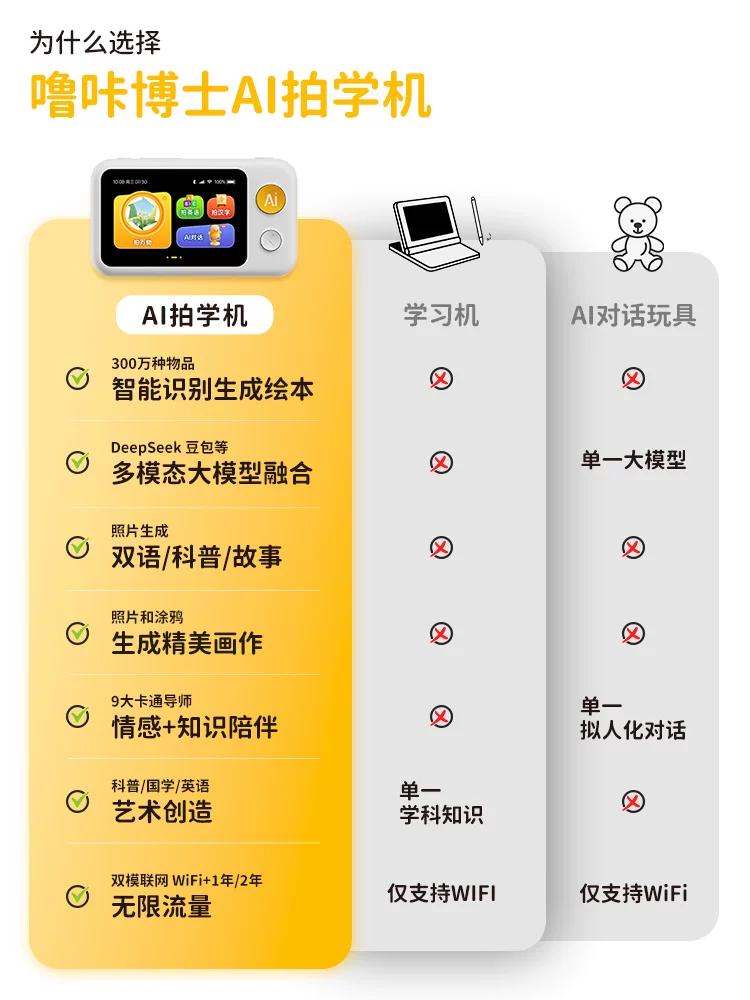
As a core team member in Intellifusion's first consumer-facing product, I led algorithm development for a lightweight multimodal model focused on open-world recognition. The model identifies the main object in an image and outputs both Chinese and English names, reaching 90% recognition accuracy and outperforming mainstream multimodal models such as GPT-4o and Qwen2-VL on this task.
By mid-2025, cumulative sales of the AI learning device exceeded 100,000 units, with total revenue surpassing RMB 66 million.


Yuntian Tianshu Large Language Model
Technical Domain: Large Language Models
Worked on pretraining, supervised fine-tuning, value alignment, data processing, and evaluation for hundred-billion-parameter language models. Our in-house models ranked first on multiple benchmarks including C-Eval and CMMLU. I also contributed to production applications including policy question answering, official document writing, and intelligent document reading.
Lossless LLM Inference Acceleration: SPACE and BiTA
Technical Domain: Efficient LLM Inference
Developed efficient inference acceleration methods including SPACE and BiTA, achieving more than 2x lossless speedup for large language models. These methods outperformed approaches such as Medusa and LookAhead and reached state-of-the-art practical performance.
An Intelligent Assistant for 12345 Hotline
Technical Domain: NLP
Developed an intelligent assistant for government hotline operators with dialog summary, ticket title generation, named entity recognition, multi-level issue classification, knowledge base retrieval, and grammar correction. The system improved customer service efficiency by more than 60%.
Battery Charge Time Prediction for Mobile Phone Users
Technical Domain: Multivariate Time Series Prediction
Formulated personalized battery charge time prediction as a sequential learning problem using millions of charging records. Designed a deep learning model and loss functions that outperformed traditional ML approaches such as XGBoost and was deployed on Huawei mobile phones.